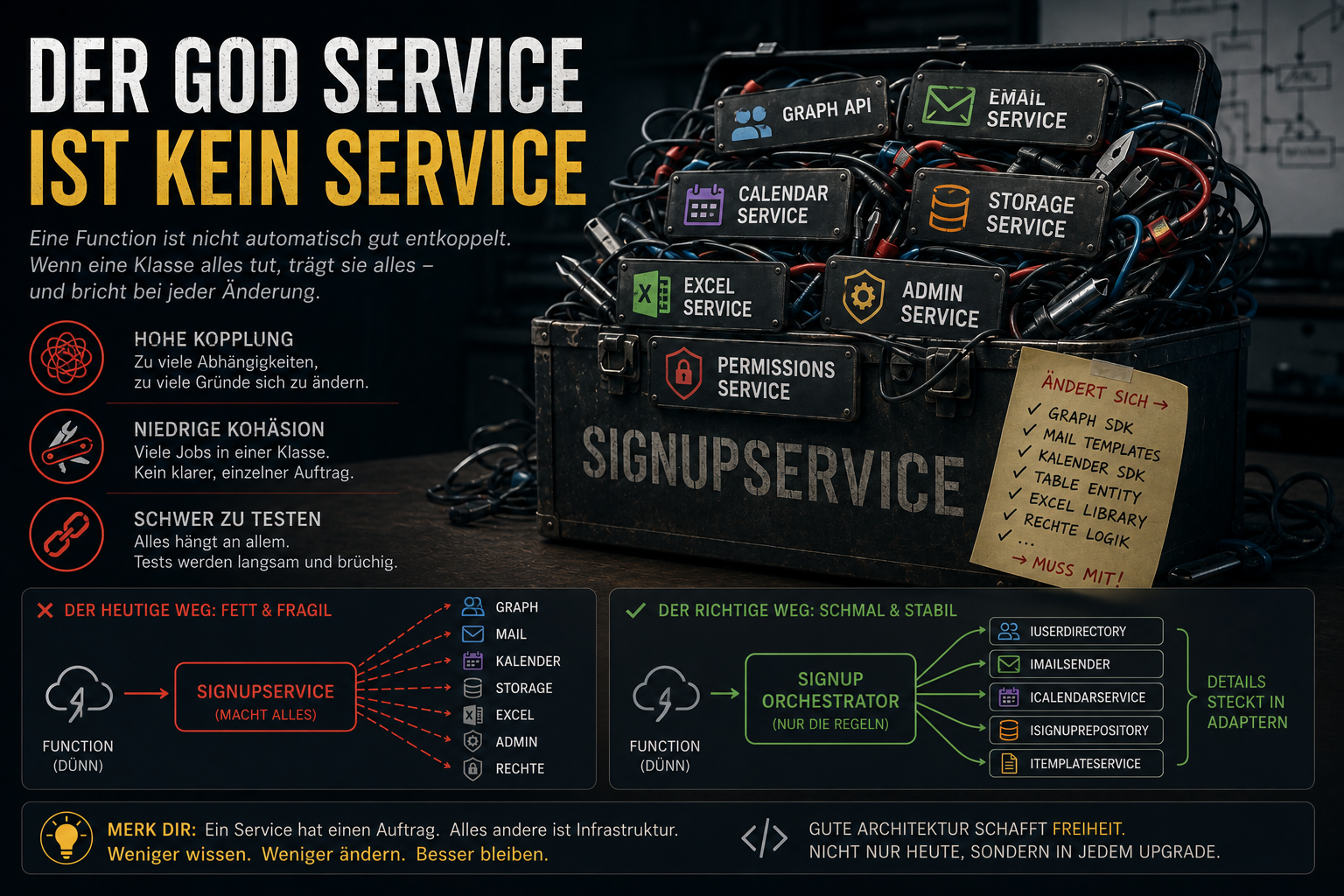
Software wird selten auf einen Schlag unwartbar. Meist passiert es schleichend. Ein kleiner Fehler taucht auf. Man behebt ihn. Danach entsteht ein Sonderfall. Auch der wird behoben. Dann ein weiterer. Dann noch…
Bei Terminalanwendungen beginnt die Arbeit oft an der falschen Stelle. Man hat eine Idee für ein Tool, baut die eigentliche Funktion und möchte dann schnell etwas Feedback im Terminal anzeigen. Also kommt…
Terminalanwendungen erleben seit einigen Jahren eine kleine Renaissance. Viele moderne Entwicklerwerkzeuge laufen wieder dort, wo Softwareentwicklung ohnehin häufig stattfindet: im Terminal. Paketmanager, Git-Werkzeuge, Cloud-CLIs und zunehmend auch KI-Assistenten zeigen, dass eine textbasierte…
Ein Skript beginnt oft harmlos. Es soll eine klar umrissene Aufgabe erledigen. Eine API aufrufen. Dateien verschieben. Daten bereinigen. Benutzer anlegen. E-Mails verarbeiten. Einen wiederkehrenden manuellen Ablauf automatisieren. Die erste Version ist…
Das Interface existiert. Es ist injiziert. Der Reviewer sieht ein I und geht weiter. Das kompiliert. Es lässt sich mocken. In der Architekturfolie steht Persistence hinter Interface. Der Caller schreibt trotzdem: Er…
Die Function ist dünn. Der Reviewer nickt. Dann öffnet man die Klasse, an die sie delegiert. Das sieht nach Schicht aus. Der Einstieg kennt weder Tabelle noch Graph. Genau das habe ich…
Warum eine Abstraktionsschicht um eine konkrete API noch keine lose Kopplung ist — und warum Schichten entscheiden, was ein Runtime-Upgrade wirklich kostet. Es gibt eine besonders gefährliche Form von Architektur, weil sie…
Was 24 Jahre WinForms über Technologieentscheidungen für langlebige Software lehren Vor einiger Zeit habe ich darüber geschrieben, warum ich C# WinForms noch lange nicht für tot halte. Damals ging es vor allem…
Es gibt interne Systeme, die über lange Zeit im Alltag verschwinden, weil sie funktionieren. Sie kosten keine Lizenz, kein Abo und keine Verhandlung mit einem Hersteller über den nächsten Release-Zug. Was sie…
Wenn der Export langsam ist, liegt der Verdacht auf der Datei. Oft liegt die Zeit davor — und der Library-Tausch ändert die Kurve nicht. Es gibt einen reflexhaften Satz, sobald ein Excel-Export…
Ob ein Join linear oder quadratisch wird, steht oft nicht in der Schleife. Es steht im Typ der Parameter. Man kann Entwickler bitten, keine lineare Suche in einer Abbildung zu schreiben. Das…
Ein Pfad ist schnell. Der andere sieht aus wie derselbe Code. Genau dort bleibt die alte Komplexität liegen. Es gibt eine bestimmte Art von Optimierung, die sich im Review besonders gut anfühlt.…
Designing Tri-State Logic for Safer and Cheaper AI Automation Most rule engines start with a simple assumption: every condition evaluates to either true or false. That sounds clean. A rule matches, or…
A Deep-Dive with Real Chrona Code Examples Many WPF applications begin with direct MessageBox.Show(...) calls. At first, this feels completely reasonable. A save confirmation here, an error dialog there, a warning before…
A Production-Grade Architecture Walkthrough from Chrona Most WPF + MVVM tutorials online demonstrate only the happy path. One ViewModel. One command. One view switch. That is useful for learning the basics, but…
Interfaces, Abstract Base Classes, Safe SQL, and Audit-Aware Persistence in Chrona Desktop applications often start with direct database access inside view models, commands, or small helper classes. At first, this looks efficient.…
Building a Desktop Application Like a Service-Oriented System Desktop applications do not fail because of XAML. They fail because architecture is postponed until complexity arrives. WPF remains one of the most powerful…
Introduction In the ever-evolving world of software architecture, the debate between monolithic and microservices architectures continues to spark discussions. While microservices have gained immense popularity for their scalability and flexibility, they also…
Is Technical Debt a Silent Killer of Productivity and Growth? Every software project has technical debt—those shortcuts we take to meet deadlines, save resources, or push out quick fixes. At first, they…
In object-oriented programming (OOP), two key approaches for code reuse and structuring are inheritance and composition. Understanding when to use each can significantly affect the scalability, maintainability, and flexibility of your applications.…
When developing software, applying established design principles helps ensure your code is clean, maintainable, and scalable. In this article, we explore some of the most important principles, including SOLID, DRY, and WET,…
When designing software systems, the concept of cohesion plays a crucial role in determining the quality and maintainability of your code. Cohesion refers to how closely related the responsibilities of a single…
In software development, the concepts of loose and tight coupling play a critical role in determining the flexibility, maintainability, and scalability of your code. Coupling refers to how interdependent different parts of…
Polymorphism is a fundamental concept in object-oriented programming (OOP) that allows objects to be treated as instances of their parent class rather than their actual derived class. This makes your code more…
Gernot Starkes Buch Effektive Softwarearchitekturen – Ein praktischer Leitfaden ist ein Standardwerk für Softwareentwickler und Architekten, die robuste, wartbare und effiziente Softwarelösungen entwerfen möchten. Mit einem klaren Fokus auf praxisnahe Methoden bietet…
https://www.aim42.org Iterative improvement in phases aim42 works iteratively in three phases (analyze, evaluate, improve) supported by crosscutting activities. For each phase, aim42 proposes a number of proven and established practices and patterns.…
https://www.dofactory.com/net/design-patterns Design patterns are reusable solutions to common software design problems that you encounter in application development. They represent best practices refined through years of experience and are essential for building maintainable…
S.O.L.I.D is an acronym for the first five object-oriented design(OOD) principles by Robert C. Martin. https://scotch.io/bar-talk/s-o-l-i-d-the-first-five-principles-of-object-oriented-design